
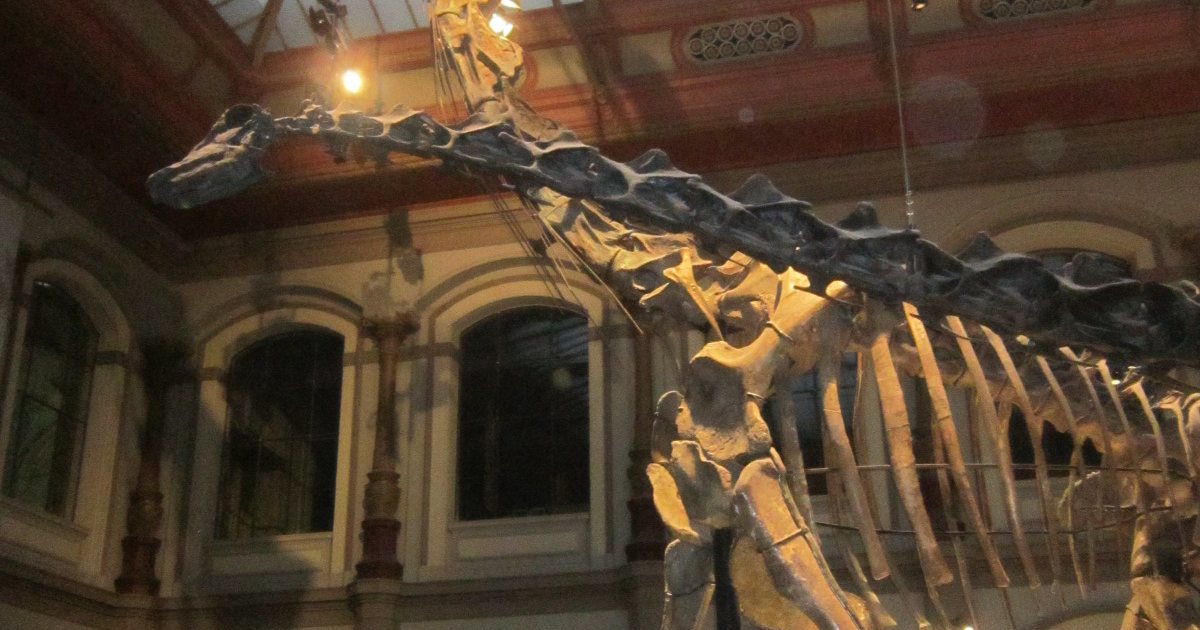
Brachiosaurus: life at fourteen metres
Holding a head nine metres above the heart is a problem in fluid mechanics before it is a problem in biology. Brachiosaurus solved it well enough to stay successful for millions of years.
Blood pressure
To push blood to the brain against that column, systolic pressure would need to be around 600 mmHg — roughly five times a human at rest. The heart required would be enormous and metabolically brutal. Proposed solutions:
- an exceptionally thick-walled ventricle
- one-way valves along the neck arteries
- a lower-slung feeding posture than classic reconstructions show
Breathing through a long pipe
A ten-metre trachea holds a large volume of stale air. Sauropods appear to have used the bird solution: air sacs threaded through hollow vertebrae, producing one-way airflow through the lungs. The bones themselves are the evidence — they are riddled with pneumatic cavities that only make sense as extensions of the respiratory system.
Every large sauropod is, in effect, a demonstration that bird-style breathing scales far better than mammal-style breathing.
Eating without chewing
There are no grinding teeth. Leaves were stripped and swallowed whole, then processed slowly in an enormous gut. A modern parallel is the tortoise: low-quality food, huge fermentation chamber, patience. Estimated intake sits near 240 kg of plant matter per day, which is a full-time occupation.
Cover image: Interfase — Public domain (source).
