
Everything is moving away from everything
Point a telescope at almost any distant galaxy and its light arrives redder than it left. The further away the galaxy, the stronger the shift — and the relationship is close to linear.
Not a normal Doppler shift
The intuitive reading is that galaxies are flying away through space. The better description is that space itself is expanding, and light stretches along with it while in transit. The difference matters: at great distances the implied recession speeds exceed the speed of light, which is fine, because nothing is moving through space at that rate.
No centre
Every observer sees everything receding from them. That sounds like it puts us in the middle, and it does not. The standard analogy is dots on an inflating balloon: each dot sees its neighbours retreat, and no dot on the surface is the centre.
If someone points at a place in the sky where the Big Bang happened, they have misunderstood the geometry. It happened everywhere, including where you are sitting.
The measurement problem
The expansion rate, the Hubble constant, can be measured two ways:
- from the cosmic microwave background — around 67 km/s per megaparsec
- from nearby supernovae and variable stars — around 73
Both are precise. They disagree by more than their error bars, and after two decades of refinement the gap has not closed. It is currently one of the most productive open problems in cosmology, because whatever explains it probably involves physics we do not yet have.
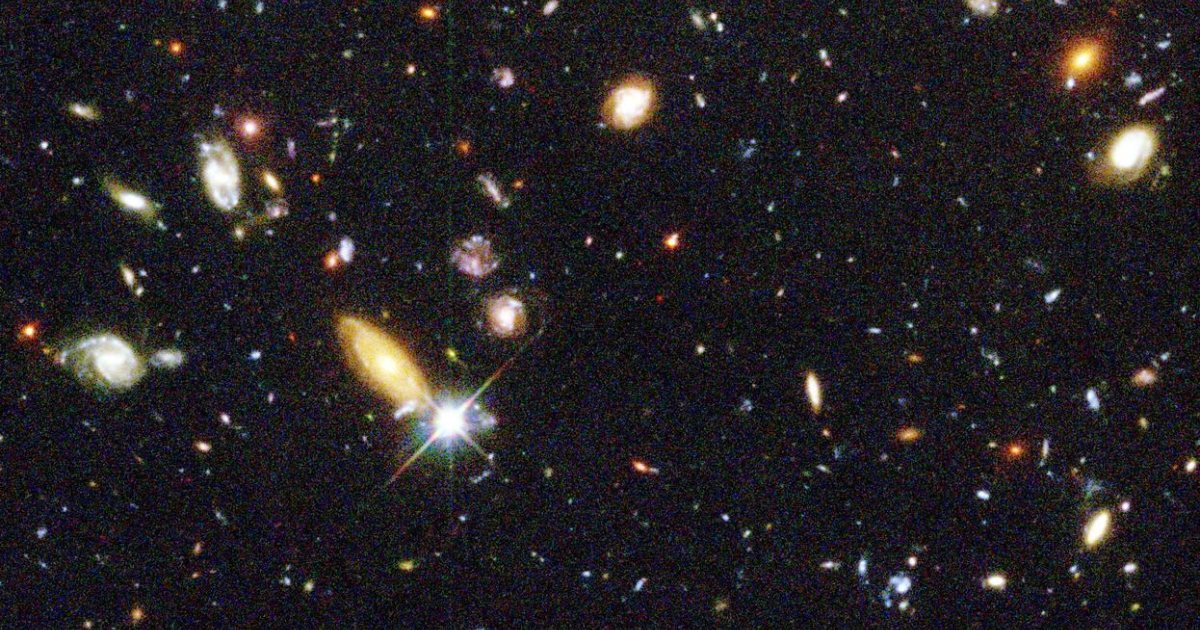
Cover image: STScI (Hubble) — Public domain (NASA) (source).